


Monday, May 18
11 A.m.–12:30 p.m. • Zoom
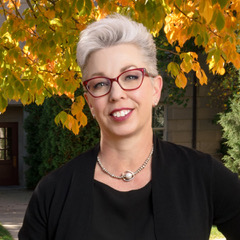
Flower Darby, PHD Candidate
Joyful Teaching in Every Class: Find Your Fizz to Boost Learning and Success
Let’s face it. Teaching these days is tough. We’re exhausted, burned out, and frustrated by the societal challenges we’re navigating today. Yet our work is important, meaningful, and worthwhile. We’re changing lives and helping dreams come true. Topics covered in this talk will include the number one finding from almost a century of research on human flourishing, a theoretical framework to help us promote well-being for everyone in class, and practical, evidence-based strategies for every class (online or in-person), every discipline, and every mode. Based on Flower’s new book, The Joyful Online Teacher: Finding Our Fizz in Asynchronous Classes, this session will help us see how to promote flourishing—our own and our students’—and rediscover the joy inherent in transformational teaching and learning.
About the speaker
Flower Darby celebrates and promotes effective teaching in all modalities to advance learning outcomes for all students. She’s an Associate Director of the Teaching for Learning Center at the University of Missouri. Prior to that, she held roles such as Assistant Dean of Online and Innovative Pedagogies and Director of Teaching for Student Success. These roles have allowed her to build on her experience teaching in person and online for 30 years in a range of subjects including Psychology, English, technology, education, leadership, dance, and Pilates. In her current work and publications, Darby empowers faculty to teach engaging classes in all modalities so that all students can learn. She is the lead author (with James M. Lang) of Small Teaching Online: Applying Learning Science in Online Classes. Her new book, The Joyful Online Teacher: Finding Our Fizz in Asynchronous Online Classes, has just been released.
Tuesday, May 19
12:15 p.m.–1:45 p.m. • Healey family Student Center GREAT ROOM

Steven Mintz, PHD
AI and the Future of Teaching: What These Tools Make Possible — and What Institutions Must Do
Higher education’s response to artificial intelligence has been largely defensive—focused on detection and restriction. That response misses the point. AI is not the problem. It exposes problems we have long ignored: we identify learning gaps too late and intervene too little; students receive minimal, often delayed feedback; and too many graduate unable to build or critique a serious argument. Used well, AI is not a threat to rigor—it is one of the best tools we have to restore it. The difference lies in how it is used. As a ghostwriter, AI replaces thinking. As a Socratic interlocutor—questioning assumptions, demanding precision, surfacing counterarguments, and exposing weak reasoning—it deepens thinking. This talk presents 22 practical ways to use AI to strengthen student learning and closes with a clear institutional agenda: redesign teaching around what AI now makes possible—timely, detailed feedback, explicit instruction in argumentation, and assessments that require real-time judgment.
About the speaker
Steven Mintz is a history professor at the University of Texas at Austin and the author or editor of 17 books, including The Learning-Centered University: Making College a More Developmental, Transformational, and Equitable Experience. A leading authority on families, the life course, and higher education’s past, politics, and future, he has also been a prominent voice in advancing more engaged, student-centered learning. He directed the University of Texas System’s Institute for Transformational Learning and Columbia University’s teaching center, and has held leadership roles as president of the Society for the History of Children and Youth and H-Net, as well as chairing the Council on Contemporary Families. A fellow at Stanford and visiting scholar at Harvard, his widely read public writing in Inside Higher Ed, The Chronicle of Higher Education, and Substack advocates for more active, project-based, and relationship-rich education.
Tuesday, May 19
2:00 P.m.–3:00 p.m. • Healey Family Student Center Social Room

Gholdy Muhammad, PHD
Cultivating Genius and Joy in Education through Culturally and Historically Responsive Pedagogies
In this session, Dr. Gholdy Muhammad offers a unique, culturally, and historically responsive approach to cultivating genius and joy in education. This approach is essential for accelerating the growth of all students and uniquely youth of color, who have been traditionally underserved in learning standards, policies, and school practices. She will present her equity framework, called the HILL Model, to help educators develop students’ histories, identities, literacies, and liberation. The HILL Model consists of five pursuits in teaching and learning:
- Identity Development: Helping youth to make sense of who they are and others.
- Skill Development: Helping youth to develop proficiencies across the content areas and state learning standards.
- Intellectual Development: Helping youth gain new knowledge set into the context of the world.
- Criticality: Helping youth name, understand, question, and disrupt oppression in the world.
- Joy: Helping youth uplift beauty, aesthetics, truth, and personal space fulfillment within humanity.
Participants will learn and understand history and policy and personal and instructional factors that justify the need and purpose for culturally and historically responsive education. Educators will be encouraged and motivated to be more inclusive of their teaching of these five collective pursuits while learning the importance of integrating cultural, racial, linguistic, and historical responsiveness into their learning goals, lesson plans, and the texts they use to teach. Additionally, participants will see sample lesson/unit plans across grade levels, moving theory into action.
About the speaker
Dr. Gholdy Muhammad is the John Corbally Endowed Professor of Literacy, Language, and Culture at the University of Illinois at Chicago. She has previously served as a classroom teacher, literacy specialist, school district administrator, curriculum director, and school board president. She studies Black historical excellence in education, intending to reframe curriculum and instruction today. Dr. Muhammad’s scholarship has appeared in leading academic journals and books. She has also received numerous national awards and is the author of the best-selling books Cultivating Genius and Unearthing Joy. She also co-authored the book Black Girls’ Literacies. Her Culturally and Historically Responsive Education Model has been adopted across thousands of U.S. schools and districts across Canada. In 2022, 2023, 2024, 2025, and 2026, she was named among the top 1% of Edu-Scholar Public Influencers for her impact on policy and practice. She has led a federal grant with the United States Department of Education to study culturally and historically responsive literacy in STEM classrooms. In the fall of 2026, her first curriculum, entitled Genius and Joy, will be available to schools and educators.
Thursday, May 21
12:00 p.m.–1:30 p.m. • 500 1st St. 9th floor convening space

Mark Fisher, PHD
Teaching Democracy in the Digital Age
What does it mean to teach “democracy” in the modern world of higher education? This plenary will encourage participants to reflect on the evolving relationship between educating students about democracy and adopting a democratic approach to education, addressing topics such as the rise of university civic centers, the role of authority in the classroom, and the meaning of democratic expertise.
About the speaker
Mark Fisher is an Assistant Professor at Georgetown University in the Department of Government and the Founding Director of the Georgetown Initiative on Artificial Intelligence and Democratic Citizenship (AIDC). His research focuses on the history and future of democratic thought, with a particular emphasis on early attempts to understand and theorize Athenian democracy.
He is currently writing two books on Thucydides as a political thinker. The first, Thucydides and the Heroic Democracy, provides a historical account of Thucydides’ analysis of Athenian democracy by situating it within the context of the Greek heroic tradition. The second, Thucydides and Political Theory, takes stock of recent attempts to place Thucydides in conversation with contemporary thinkers on themes such as the cause(s) of war, political necessity, national identity, and democratic backsliding.
He has held visiting research fellowships at the University of Oxford and the Freie Universität, Berlin. His work has been funded by the National Endowment for the Humanities, the American Council of Learned Societies, the Loeb Classical Library Foundation, and the Andrew W. Mellon Foundation.